
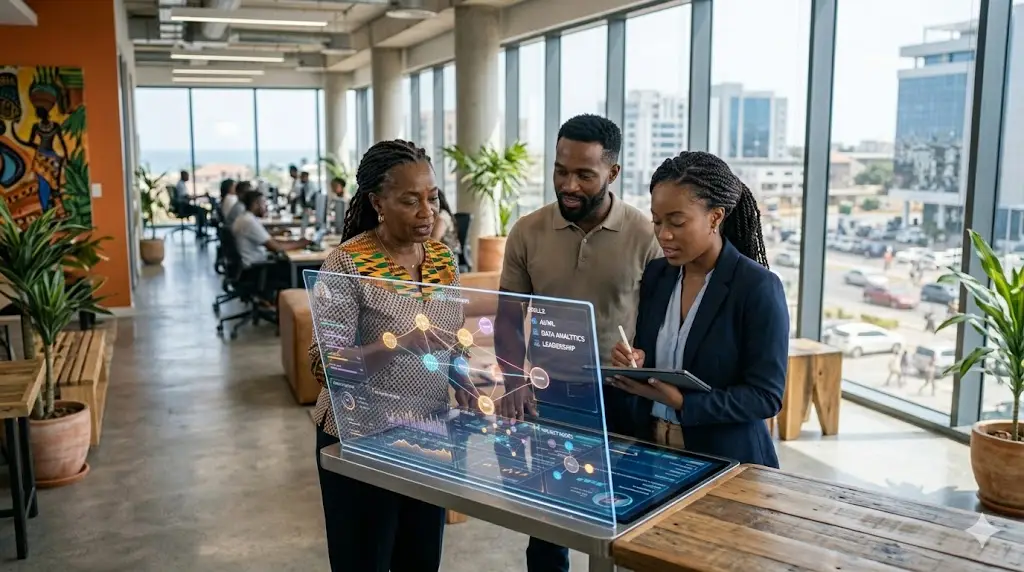
At Insight HR Solutions, we believe the future of talent management is not defined by job titles but by skills, adaptability, and intelligent collaboration with technology. As organizations in Ghana and across the globe face rapid digital transformation, traditional HR models are quickly becoming obsolete. Today’s competitive advantage lies in how well companies can identify, deploy, and grow skills dynamically.
This is where skills-based talent management, powered by artificial intelligence (AI), is reshaping the workforce.
1. Moving Beyond Job Titles to Skills and Competencies
For decades, organizations structured their workforce around rigid job titles and hierarchies. However, this model is increasingly misaligned with the pace of change in today’s economy.
A growing body of research shows that employers are shifting toward skills-first hiring and talent management, prioritizing what employees can do over what roles they have held. In fact, recent studies indicate that skills—especially in emerging fields like AI—are becoming more valuable than traditional qualifications, with measurable wage premiums attached to them. ()
This shift is driven by three realities:
- Jobs are evolving faster than job descriptions can keep up
- Many roles now require hybrid, cross-functional capabilities
- Organizations need agility, not rigidity
As a result, forward-thinking companies are redesigning roles into collections of skills and tasks, rather than fixed positions. This allows them to redeploy talent quickly, innovate faster, and remain competitive.
2. Internal AI Talent Marketplaces: Unlocking Hidden Potential
One of the most transformative tools enabling this shift is the internal AI-powered talent marketplace.
An internal talent marketplace is a digital platform that uses AI to match employees to opportunities—projects, roles, or learning experiences—based on their skills, interests, and career aspirations. ()
These systems deliver significant value:
Smarter Talent Allocation
AI enables real-time matching of employees to business needs, ensuring the right skills are deployed at the right time.
Closing Skills Gaps
Organizations can identify existing capabilities and gaps, then proactively upskill or reskill their workforce. ()
Increased Retention and Engagement
Employees gain visibility into internal opportunities, reducing the need to look externally for growth. ()
Improved Organizational Performance
Companies that effectively mobilize internal talent are 2.4 times more likely to outperform their peers. ()
Globally, organizations like Standard Chartered have already adopted internal “gig-style” marketplaces, where employees work on projects based on their skills rather than fixed roles—unlocking millions in value and accelerating innovation.
For Ghanaian businesses, this represents a powerful opportunity to maximize existing talent instead of relying solely on external hiring.
3. Redesigning Jobs for Human–AI Collaboration
A common misconception is that AI will replace jobs. In reality, evidence shows that AI is reshaping jobs rather than eliminating them.
Recent data suggests that:
- Only about 25% of jobs are highly transformable by AI
- Around 40% will become hybrid roles, combining human and AI capabilities
This means the future workforce will not be human or AI but human with AI.
What does this look like in practice?
- Routine tasks are automated by AI
- Humans focus on judgment, creativity, and relationships
- Roles are redesigned into collaborative systems between people and machines
For example:
- Recruiters use AI to screen candidates but apply human judgment in final decisions
- Marketers use AI for analytics but drive strategy and storytelling
- HR professionals use AI insights to design personalized employee experiences
Organizations that embrace this model report increased productivity, with some AI-enabled systems saving employees significant time daily and allowing HR teams to focus on strategic impact.
4. The Strategic Imperative for Ghanaian Organizations
In Ghana’s fast-growing economy, businesses face challenges such as:
- Skills shortages in digital and technical fields
- High competition for top talent
- The need to scale efficiently
Skills-based talent management offers a practical solution:
- Build from within instead of competing endlessly for external talent
- Develop future-ready skills pipelines
- Enhance workforce resilience and agility
By integrating AI into HR processes, organizations can move from reactive hiring to proactive talent strategy a critical shift for long-term growth.
5. Key Steps to Get Started
At Insight HR Solutions, we recommend the following roadmap:
1. Map Skills Across the Organization
Create a dynamic inventory of employee skills—not just job titles.
2. Implement an Internal Talent Marketplace
Leverage AI tools to match skills with opportunities in real time.
3. Redesign Roles into Skill-Based Work
Break jobs into tasks and capabilities that can evolve.
4. Invest in Continuous Learning
Support upskilling and reskilling aligned with business needs.
5. Build a Human–AI Collaboration Culture
Train employees to work alongside AI, not compete with it.
Conclusion: The Future Belongs to Skills, Not Titles
The organizations that will thrive in the next decade are those that understand one simple truth:
Talent is no longer defined by position—it is defined by capability.
Skills-based talent management, powered by AI and internal mobility, is not just a trend it is the foundation of the future of work.
At Insight HR Solutions, we are committed to helping organizations in Ghana transition from traditional HR models to intelligent, skills-driven ecosystems where people, technology, and opportunity come together to drive sustainable growth.
Ready to transform your workforce? Partner with Insight HR Solutions and lead the future of work in Ghana.